
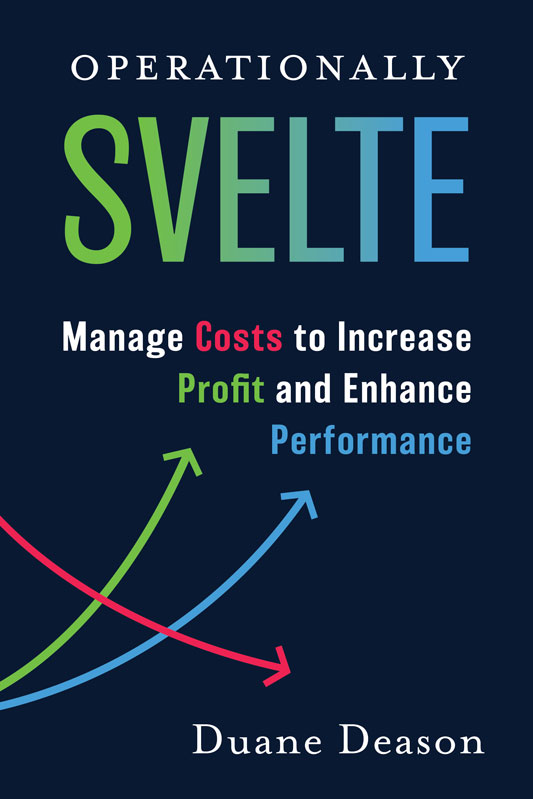
Operationally Svelte
Manage Costs to Increase Profit and Enhance Performance
Are growth, innovation, and profitability mutually exclusive? Absolutely not. The key to achieving all three objectives is keeping your company lean.
Bloat creeps into companies as they grow. It dulls cutting-edge innovation, slows response to changing economic conditions, whittles down profitability, and hinders growth. You will not curtail organizational bloat by doing what you have always done. Companies need a new strategy.
In this book, author Duane Deason presents a refreshing approach to making an organization lean and unleashing its potential: create a Cost Management Center. Think of it this way—while your Sales team focuses on revenue, your Cost Management Center focuses on managing and controlling costs throughout the organization.
Get step-by-step advice to establish a Cost Management Center to eliminate the common culprits of bloat, waste, and inefficiency. Then dive into tips and strategies to maximize the effectiveness of that initiative to transform your company. In doing so, you will be well positioned for optimal performance, enhanced growth, superior innovation, and increased profit.
To receive information and updates, please provide your contact information:
Book Quotes
- Organizational bloat creeps into companies as they grow. It dulls cutting-edge innovation, slows responses to changing economic conditions, whittles down profitability, and hinders growth. You will not curtail it by doing what you have always done. Companies need a new strategy.
- Think of it this way—while your Sales team focuses on revenue, your Cost Management Center team focuses on controlling costs throughout the organization. With this new structure addressing bloat, waste, and inefficiency, your organization will become nimble, energized, and capable of reaching its full potential.
- The professional journey of an individual in the field of cost management is a challenging trek. It’s not the path for those seeking recognition, admiration, or companionship.
- It is an unfortunate truth that growth and innovation can seemingly be lost overnight, but the harmful elements of bloat, waste, and inefficiency are incredibly sticky.
- To repurpose the phrasing of the famous quote about greed from the movie Wall Street: Lean is good. Lean is right. Lean works. Lean clarifies, cuts through, and captures the essence of the evolutionary spirit.
- Growth without bloat
- Many executives are experts in their respective roles but clumsy at managing the underlying costs that support their function.
- It is easy to assume that because you’re using the latest budgeting software and have a financial planning and analysis team big enough to overthrow most governments, you’re surely on the cutting edge of monitoring the business.
- Being within budget differs from spending capital efficiently. You can be within budget and spend inefficiently. I don’t regard budgets or forecasts as the holy grail of cost management. They are useful tools, but they are too blunt to be effective in managing costs on their own.
- Few leaders are effective at cost management. That pains me to say because it doesn’t mean those leaders aren’t good at their roles. It’s more the case that cost management is a sideshow to most of them, not their area of expertise.
- Understanding what you want out of something is the first step in deciding what you need to put into it.
- Cost efficiency leads to operational efficiency, with “lean and mean” being two sides of the same coin.
- For the Cost Management Center, it is worthwhile to understand how the process should work (the science) and how it actually works (the art).
- When it comes to the saying, “Spend the company’s money like it’s your own,” I suggest you be careful what you wish for.
- I’m reminded of the “Serenity Prayer,” which I will put into business terms: God grant me the determination to pursue ideas that will benefit the company, the strength to reject the ideas that will distract the company, and a manager who knows the difference.
- Processes and functions that are cumbersome are costly to a company because they are distractions from employees’ core duties and responsibilities.
- It is difficult for trust to evolve in any unpredictable or inconsistent environment or relationship.
- In some ways, the Cost Management Center is like law enforcement, whereby they have a dual role—to enforce the law but also to help citizens in need.
- If I had to identify the most significant factor in a company’s ability to properly manage costs and operate efficiently, it would be its culture of cost awareness.
- It might not surprise you to learn that the cultural components behind either waste or efficiency are equally contagious within a corporation.
- To rephrase one of Sir Isaac Newton’s laws of motion, a cost in motion remains in motion.
- I can’t tell you how many times I’ve seen a manager be willing to go to the mattresses to get their consultants annual raises that are three times more than the expected CPI inflation increase, when their own employees get a fraction of that as an annual pay raise.
- Tech is treated like clothes shopping, where everyone has a different preference, wants to try on lots of options, and has the inherent right to return those items later if they decide they don’t look good in the mirror at home. Unfortunately, an analogy closer to reality is shopping for clothes online with a no-return policy.
- The problem arises when companies overeat at the technology smorgasbord and suffer from tech bloat—a common condition when companies have too many poorly integrated technologies doing too many similar things for too many small groups of employees.
- I enjoyed the movie Everything Everywhere All at Once, but it makes a poor operating model for a newly established Cost Management Center. Barring a financial crisis, resist any initial temptation to demonstrate the full authority of the Cost Management Center by attacking all cost areas simultaneously with reckless abandon. It’s a good way to get the entire initiative marginalized everywhere all at once.
- Most companies start their renewal negotiations a few months before the current contract is set to expire, yet they would need an extended period of time, sometimes even years, to transition off an application. You might as well be in the desert trying to negotiate a price with the only water vendor.
- Consulting is not a “get them in now, and we’ll figure out the details later” situation unless you have plenty of money to spare.
- The implication is that being an attractive organization is, in itself, a cost strategy because you can afford to pay less compensation.
- If a supervisor can’t determine solid measurements of accountability for their employees, then perhaps that individual should not be supervising.
- First, growth and efficiency are not mutually exclusive but, instead, complement each other. Lean organizations enjoy lower costs and higher performance. Lean organizations are not weighed down by the common culprits of bloat, waste, and inefficiency.
- Inefficiency is, in the long run, an organizational cancer that is often terminal.
- Beyond these points is a word of caution that the traditional structure to manage costs does not lead to good places. Eventually, you’ll be left trying to address systemic efficiency problems when forced to do so by circumstances, such as when facing a financial crisis. Being in this position is akin to how the captain of the Titanic must have felt when he knew he couldn’t turn the ship fast enough to avoid the iceberg. At that point, all he could do was hope the damage wouldn’t be enough to sink the ship, and we all know how that turned out.
- By implementing the cost management structure I have recommended and outlined, you will have a stronger company with optimal performance, enhanced growth, superior innovation, and increased profit. Your organization will be well positioned to weather downturns, fend off competition, and navigate through changing economic cycles.
- Helping a company reduce its costs and improve efficiency is like plastic surgery; customers want the benefits without ever admitting they had the service.